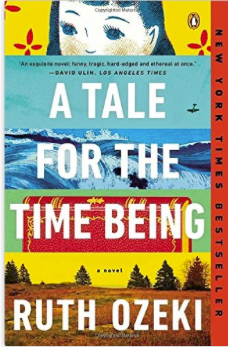
This blog has, from time to time, has asked the question, "What is art?" so when I read this part of A Tale for the Time Being by Ruth Ozeki, I thought I would share it with you. The fictional version of the author is married to an artist,
"He was the least egotistical man she'd ever met, nor was he particularly ambitious. His land art projects, like the Means of Production, he deemed successful only when he himself had disappeared from them.
And I have to say, also: READ THIS BOOK. Or listen to it. The audio book is read by the author with singing and expression and chanting and loveliness. It seems weird at first, but go with it. It questions the nature of reality, and somehow does it in a believable way. And it surprised me. So few books really surprise me anymore.
Showing posts with label What is art?. Show all posts
Harry Bertoia
Harry Bertoia was a designer who made a most wondrous chair. The chair was so successful that he could then devote the rest of his life to sound sculptures. The sculptures, when touched, created haunting sounds.
Sometimes my blog here touches on the subject, "What is art?" This is definitely art.
Full vintage documentary here.
Guest Blogger: Jennifer Parnell
What is Art?
Robin and Rothko
A picture lives by companionship, expanding and quickening in the eyes of the sensitive observer. It dies by the same token. It is therefore a risky and unfeeling act to send it out into the world. How often it must be permanently impaired by the eyes of the vulgar and the cruelty of the impotent who would extend the affliction universally! ” — Mark Rothko
I don’t “think” about Art all that often. In fact, days will go by without me thinking of Art at all. I am much more likely to think about what I am going to do with my pets in the event of a Zombie Apocalypse. I am more likely to ponder the beauty of an ice cold beer than to reflect on the merits of Dadaism. I, in other words, am like most people, except for the fact that I trained as an Art Historian. Yes, I am actually knowledgeable which surprises even me. It’s like my dirty little secret. I love Art. Life just got in the way. So when I do get the opportunity to think about, see, or discuss Art, it is a real treat. Those opportunities are few and far between, but I do get them occasionally, like when I spend the day with my friend Robin.
Robin is a “work” friend which is really the only new kind of friends I make now a days, considering that I am an introverted hermit (not that it’s a bad thing). Robin is a writer but like most artists she works a day job. She is in her 40s, independent, hysterical, well read, and probably a little crazy. Robin loves to go to museums. She is a member at all the San Francisco museums and whenever there is a new show she thinks to call me. It is great because she gets me in for free, and she likes to drink and gossip. Always a pretty good time except when we see anything that is considered Abstract.
Robin is not a fan of non- representational Art. She is one of those people that look at a Jackson Pollock and go “I could do that!” No Robin, you couldn’t. Trust me. I put up with it because I get it: Abstract Art is not for everyone. It wasn’t my field. I studied the Pre-Raphaelites and Bay Area Muralists in the 1930s. But I love all art (except Dale Chihuly) and I try to defend Abstraction when I am with Robin. Most of the time it ends in a drunken shouting match where I call her a philistine and she calls me an Ivory Tower elitist. I tell her I can see the Ivory tower from the ghetto (Literally I can. I live across the street from Stanford.) We then usually go have a drink and talk about Harper Beckham.
Our greatest arguments are always about one of my favorite artists, Mark Rothko.
Sexy Beast Mark Rothko
Here is a quick Art History recap- Mark Rothko was an abstract artist of the post-war generation. He is most well-known for his large scale “color block” paintings (also known as multi-form paintings.) He was born in Latvia in 1903, came to America as a child, went to and dropped out of Yale, and became one of the most famous of the Abstract Expressionists. He wrote about Art frequently, and was a great thinker as well as a great painter. He committed suicide in 1970 by overdosing on anti-depressants. He also slit his wrists for good measure. In other words, he was a serious dude. Here is some of his Art:


These pictures don’t do his work justice, but you get the idea. I loved Rothko from the moment I was exposed to him. His abstraction was accessible, emotional. Warm and relatable. The first time I went to New York I saw a Rothko exhibition at the Whitney. The girl I was with had to leave, it was so overwhelming to her. Being in that room, surrounded by these massive paintings of pure color—it was as close to a spiritual experience as I will ever get. When I tried to explain this to Robin she said “it’s just color!” I then accused her of being dead inside and we didn’t talk for a week. After we made up and went to a museum again, we had the same argument! I tried to explain to her why Rothko matters; she tried to tell me a child could paint this. I bought her a book called “Modern Art for Dummies” and she bought me a Chihuly catalogue. This has gone on for years. It is our great Art fight and I love it. I feel like I am fighting the good fight, which I don’t often get to do. Robin asks “Why is this Art?” I explain theory and form and composition. I explain the history and what lead Rothko to this style. I explain the emotional impact it has on me. I try to explain being in a large room, filled with color and silence. “Use your imagination Robin! You are a goddamn writer!” She looks at me like I am crazy. And damn, maybe I am. But Rothko’s work IS what Art is all about- changing the way you see things, giving you an emotional experience, educating you… Maybe you have to be in room full of Rothko’s to understand. I can only hope a Rothko exhibition comes our way. I think it would be a very disturbing/enlightening experience for Robin. Then again, maybe it wouldn’t. Maybe the only thing Robin and I will ever agree on when it comes to Modern Art is that Dale Chihuly is a total asshole.

When she isn't arguing about Rothko, Jen generally writes hilarious monologues about her other love.
Robin and Rothko
A picture lives by companionship, expanding and quickening in the eyes of the sensitive observer. It dies by the same token. It is therefore a risky and unfeeling act to send it out into the world. How often it must be permanently impaired by the eyes of the vulgar and the cruelty of the impotent who would extend the affliction universally! ” — Mark Rothko
I don’t “think” about Art all that often. In fact, days will go by without me thinking of Art at all. I am much more likely to think about what I am going to do with my pets in the event of a Zombie Apocalypse. I am more likely to ponder the beauty of an ice cold beer than to reflect on the merits of Dadaism. I, in other words, am like most people, except for the fact that I trained as an Art Historian. Yes, I am actually knowledgeable which surprises even me. It’s like my dirty little secret. I love Art. Life just got in the way. So when I do get the opportunity to think about, see, or discuss Art, it is a real treat. Those opportunities are few and far between, but I do get them occasionally, like when I spend the day with my friend Robin.
Robin is a “work” friend which is really the only new kind of friends I make now a days, considering that I am an introverted hermit (not that it’s a bad thing). Robin is a writer but like most artists she works a day job. She is in her 40s, independent, hysterical, well read, and probably a little crazy. Robin loves to go to museums. She is a member at all the San Francisco museums and whenever there is a new show she thinks to call me. It is great because she gets me in for free, and she likes to drink and gossip. Always a pretty good time except when we see anything that is considered Abstract.
Robin is not a fan of non- representational Art. She is one of those people that look at a Jackson Pollock and go “I could do that!” No Robin, you couldn’t. Trust me. I put up with it because I get it: Abstract Art is not for everyone. It wasn’t my field. I studied the Pre-Raphaelites and Bay Area Muralists in the 1930s. But I love all art (except Dale Chihuly) and I try to defend Abstraction when I am with Robin. Most of the time it ends in a drunken shouting match where I call her a philistine and she calls me an Ivory Tower elitist. I tell her I can see the Ivory tower from the ghetto (Literally I can. I live across the street from Stanford.) We then usually go have a drink and talk about Harper Beckham.
Our greatest arguments are always about one of my favorite artists, Mark Rothko.
Sexy Beast Mark RothkoHere is a quick Art History recap- Mark Rothko was an abstract artist of the post-war generation. He is most well-known for his large scale “color block” paintings (also known as multi-form paintings.) He was born in Latvia in 1903, came to America as a child, went to and dropped out of Yale, and became one of the most famous of the Abstract Expressionists. He wrote about Art frequently, and was a great thinker as well as a great painter. He committed suicide in 1970 by overdosing on anti-depressants. He also slit his wrists for good measure. In other words, he was a serious dude. Here is some of his Art:


These pictures don’t do his work justice, but you get the idea. I loved Rothko from the moment I was exposed to him. His abstraction was accessible, emotional. Warm and relatable. The first time I went to New York I saw a Rothko exhibition at the Whitney. The girl I was with had to leave, it was so overwhelming to her. Being in that room, surrounded by these massive paintings of pure color—it was as close to a spiritual experience as I will ever get. When I tried to explain this to Robin she said “it’s just color!” I then accused her of being dead inside and we didn’t talk for a week. After we made up and went to a museum again, we had the same argument! I tried to explain to her why Rothko matters; she tried to tell me a child could paint this. I bought her a book called “Modern Art for Dummies” and she bought me a Chihuly catalogue. This has gone on for years. It is our great Art fight and I love it. I feel like I am fighting the good fight, which I don’t often get to do. Robin asks “Why is this Art?” I explain theory and form and composition. I explain the history and what lead Rothko to this style. I explain the emotional impact it has on me. I try to explain being in a large room, filled with color and silence. “Use your imagination Robin! You are a goddamn writer!” She looks at me like I am crazy. And damn, maybe I am. But Rothko’s work IS what Art is all about- changing the way you see things, giving you an emotional experience, educating you… Maybe you have to be in room full of Rothko’s to understand. I can only hope a Rothko exhibition comes our way. I think it would be a very disturbing/enlightening experience for Robin. Then again, maybe it wouldn’t. Maybe the only thing Robin and I will ever agree on when it comes to Modern Art is that Dale Chihuly is a total asshole.

When she isn't arguing about Rothko, Jen generally writes hilarious monologues about her other love.
Guest Writer/ Artist/ Musician Dennis C. Lee: What is Art?


What is Art?
Recently, I am reading Camille Paglia’s ‘Sexual Personae’ and I come across this; “Freud has no rivals among his successors because they think he wrote science, when in fact he wrote art.” It feels good seeing someone write what I’d always felt.
The distance between science and art never was a deep divide. The myth lingers that the founders of modern chemistry, the Alchemists, had a get rich quick scheme to turn lead into gold. The Christians, notorious for stifling progression with fear of change, naturally, fabricated this. What the Alchemists sought was a metaphorical gold of the spirit; their use of proto-pagan symbols verifies this.
But I don’t intend to be Christian-bashing here – whose architects have been masters of the fusion of art and spirit in the western world for the better part of two millennium. I feel with in the question ‘What Is Art’ there is a strong need to define what is real as opposed to what is imagined; therein lies the true freedom of the individual.
To define the division between science and art is to define the connection as well, for one cannot exist without the other. At the most basic, the art of language; science would be lost without it. And the science of transmission – television for example, so much art would not have been created, or perhaps simply altered to suit another medium. Is it a fine line in the mind that separates the real from the imagined, or is art the struggle to define what is real in metaphorical terms?
The thing is, we all live vicariously through the arts. When we have actual, visceral experience, part of our innate social pact is to share that experience, so that others may have our experience vicariously. Not everyone takes up the challenge, though. The few who do the art of their experience get called ‘artists’.
One of the greatest problems with religious art is that it merely repeats a vicarious experience of another, and so on. Their audience feels a need to even further detach itself from the original artist, making the work more mythological and fictitious. Which brings us to the question of how valid as experience IS the original? Since all art is metaphor, the paradox is that even so-called representational art, let’s say, an artist invites patrons into a forest and says; ‘this tree is my artwork, and I call this piece ‘Tree’. The moment it is perceived as art, it is no longer itself but is instead a representation of itself.
Is art a piffling night’s entertainment for the jaded as much as it is a salve for the helpless, the wretched and the damned? At what point does the art of yoga become the science of health?
Art has no inherent morality. Personally, I’d like to think of myself as one who seeks the type of art that would challenge, or at least test, whatever preconceptions I’ve picked up. However, all my initial reactions tend to be pedantic, as predictable as a caged animal. It often takes me years of separation from the stimuli of the original art to realize how much I’ve assumed. The mind protects itself, often using faulty logic and imagining trauma where there is none. Bad art will support, enable our assumptions, biases and paranoias. Good art will challenge us and question all potential illusions.
Coming soon: What is Art? Revisited
I've invited artist Dennis C. Lee to write a guest post on the topic, "What is art?" I'm looking forward to seeing what he writes. In addition to being an amazing artist and songwriter, Dennis is, of course, my weird uncle.
Dennis was recently the subject of someone else's art. Brian McCall did a gigantic mural of Western Pennsylvania musicians at the Keynote Cafe in Jeanette, Pennsylvania:

And that, ladies and gentlemen, is art! Well done, Brian McCall.
Uncle Dennis is on his keyboard:

Look for a guest post from Dennis C. Lee in the near future...
Dennis was recently the subject of someone else's art. Brian McCall did a gigantic mural of Western Pennsylvania musicians at the Keynote Cafe in Jeanette, Pennsylvania:

And that, ladies and gentlemen, is art! Well done, Brian McCall.
Uncle Dennis is on his keyboard:

Look for a guest post from Dennis C. Lee in the near future...
Subscribe to:
Posts (Atom)