 |
| You're not good enough |

Showing posts with label Wanda Gág. Show all posts
Showing posts with label Wanda Gág. Show all posts


Wanda Wednesday: Still true
Today, we have a quote from Wanda Gág:
"One of the big reasons why women have accomplished so little in the line of art, literature and so on is because they have wasted too much time looking pretty for the men so that they might continue to desire them- wasting time."
"One of the big reasons why women have accomplished so little in the line of art, literature and so on is because they have wasted too much time looking pretty for the men so that they might continue to desire them- wasting time."
Wanda Wednesday: The End of World War One
My book (Wanda Gág by Augur H. Winnan) arrived, and it is everything I had hoped for. The book contains lots of art, and, best of all, many diary entries and letters of the time! This real and specific slice of history continues to fascinate me: American history as told, day to day, through the eyes of an amazing and unique person. I immediately dove right in and started reading. You may remember that Growing Pains ended with Wanda getting a scholarship to go study art in New York City. The following is a diary excerpt from November 10, 1918, New York,
"A few people found streamers. Others, lacking the regulation kind, used toilet paper instead. In fact, no one who was on the Avenue that day will ever blush at the sight of that article again. It dropped from windows and floated across the streets unfurling itself into graceful serpentine ribbons, it turned itself about people and grew from the trees. And all this time the snow went on, thicker and faster and gayer. You could see balconies dripping them, windows shedding them, trees bearing them. It lay on the window sills like snow in winter, one waded through it as one does through leaves after a sharp and sudden frost in autumn. The streamers hung like icicles from buildings, trees and vehicles.
"I passed a big silk store. They had snipped paper of blue and white, but needing also red, they had mingled red silk cuttings with the rest.
"By this time, of course, people had recovered from the first shock and were making noise in all the different ways they could devise. All bells, horns, tin pans, pie-plates, old kettles, pails and iron pipes were brought into service and pandemonium reigned supreme. People were positively silly with joy. One man had long hair and a beard made of orange crepe paper streamers, others had strips of toilet paper tied about their heads with a big foolish perking bow in front. Horses rejoiced in the same idiotic trimmings. All vehicles from auto trucks to Black and white taxis were crowded with a motley mass of people, who waved and yelled and held up the extras, which bore in big legend:
Then comes the entry for January 6, 1919,
"It was a fake peace announcement. But real peace came several days later with much the same commotion and excitement." (Page 210)
"A few people found streamers. Others, lacking the regulation kind, used toilet paper instead. In fact, no one who was on the Avenue that day will ever blush at the sight of that article again. It dropped from windows and floated across the streets unfurling itself into graceful serpentine ribbons, it turned itself about people and grew from the trees. And all this time the snow went on, thicker and faster and gayer. You could see balconies dripping them, windows shedding them, trees bearing them. It lay on the window sills like snow in winter, one waded through it as one does through leaves after a sharp and sudden frost in autumn. The streamers hung like icicles from buildings, trees and vehicles.
"I passed a big silk store. They had snipped paper of blue and white, but needing also red, they had mingled red silk cuttings with the rest.
"By this time, of course, people had recovered from the first shock and were making noise in all the different ways they could devise. All bells, horns, tin pans, pie-plates, old kettles, pails and iron pipes were brought into service and pandemonium reigned supreme. People were positively silly with joy. One man had long hair and a beard made of orange crepe paper streamers, others had strips of toilet paper tied about their heads with a big foolish perking bow in front. Horses rejoiced in the same idiotic trimmings. All vehicles from auto trucks to Black and white taxis were crowded with a motley mass of people, who waved and yelled and held up the extras, which bore in big legend:
"GERMANY SURRENDERS"
(Page 209, Wanda Gág, compiled by Audur H. Winnan) |
| Picture from Clickamericana.com (Wanda is in there, somewhere.) |
"It was a fake peace announcement. But real peace came several days later with much the same commotion and excitement." (Page 210)
Wanda Wednesday: Wanda Ga'g: A Catalogue Raisonne of the Prints
I ordered another book about Wanda Gág (there aren't that many, though). Looking forward to deciphering the clues... there's no description (oddly), but the one review (from "Teoslola ") says,
"This book is a bit disjointed as it is more or less in parts that are not connected well but her art and her diary entries make up for this. Highly recommended."

I can't wait to see more of her art! And I'm hoping there are diaries from later periods in her life.
"This book is a bit disjointed as it is more or less in parts that are not connected well but her art and her diary entries make up for this. Highly recommended."

I can't wait to see more of her art! And I'm hoping there are diaries from later periods in her life.
Wanda Wednesday: Sex
One of the first things that really interested me about Wanda Gág was that she seemed really sexually liberated for her time. Actually, she was really sexually liberated for anyone's time. Professor Batty published a photograph on his blog of Wanda wedged between two laughing men, both of whom were her lovers, at the same time, and both were quite totally okay with that. Laughing. (The third guy was not a lover, just happy.)
There's only one other woman I know of who has pulled that off, even in modern times, and her two boys have never, as far as I know, posed for a picture together with her.
So, I approached the diary frankly fascinated with her sex life. And then, spoiler alert, Growing Pains has no sex at all. In her teen years, Wanda Gág was an absolute celibate in every way. She goes on at length in several diary entries about why it is important to her not to let any boy touch her. At all. Not to let them hold her hand. Nothing. The boys (her "cavaliers"), perhaps seeking a challenge, find her all the more desirable for this.
She slowly warms up to different sorts of bodily contact, but very slowly.
"While we were talking, Donnie's arm stole round my shoulder. Now I have always had about half a dozen remarks in readiness for the boy who would ever put his arm around me- and I never said a single one, I don't know why I didn't, but I didn't, that's all. In the first place, I was so surprised that I was mute for a while; in the second place, it was done in such a nice comradely way that I didn't have the heart to say anything; and in the their place, I liked it. I repeat it- I liked it. I'm shocked at myself but- well I hope no one will criticize anything until they've gone thru the same thing themselves. And Donald had never acted soft anyway." (page 155, Growing Pains)
At the end of Growing Pains, Mr. Adolph Dehn and Wanda have become very good friends, and fallen a little bit in love- not head over heals in love, but that sort of I know you so well and I just noticed how great you are kind of love. They've worked together on several artistic projects, and they eat lunch together every day. One day, they go fishing in a rowboat together. After a somewhat romantic walk, she describes how Adolph makes a small advance,
'"May I kiss your hand, Wanda? Just once' he asked. I said, 'No,' at first but then I let him take it." (p. 449)
Eventually, after a few romantic nights, she lets him kiss her- twice, if I remember correctly. On the face, even. The kiss is a really big deal for Wanda. And then they both, somehow, get scholarships to go to New York City! And then it's over. No more diary. But you have to know, from pictures like the one above, that things really turn out all right for them. And it makes you happy.
I still have a feeling of unfinished business. I need to read more about Wanda. What really interests me, as much as her art and her philosophy, is her sex life. I don't want to know the details of sexual acts or anything. That doesn't interest me. What I really want to know is, How do you go from not letting a man touch you in any way, to having sex with whomever you please and enjoying it? How is that the same person? How is it that you, Wanda, how are you always this contradiction, this amazing enigma? How do you embody two polar moral opposites, in the same body, the same soul? And how are you so happy in doing so? How do you rebel against the social constrictions of your time, and still be a successful children's book author?
I'm glad that Professor Batty is currently writing a book (based on his recent research) which will answer all of our questions. It is much needed. He doesn't have a title or a release date yet... actually, he doesn't know he's doing it yet. But he will. Right?
 |
| Rockwell Kent... Carl Zigrosser (lover)... Wanda Gág... Adolph Dehn (lover, often referred to as "Mr. Dehn") |
There's only one other woman I know of who has pulled that off, even in modern times, and her two boys have never, as far as I know, posed for a picture together with her.
So, I approached the diary frankly fascinated with her sex life. And then, spoiler alert, Growing Pains has no sex at all. In her teen years, Wanda Gág was an absolute celibate in every way. She goes on at length in several diary entries about why it is important to her not to let any boy touch her. At all. Not to let them hold her hand. Nothing. The boys (her "cavaliers"), perhaps seeking a challenge, find her all the more desirable for this.
She slowly warms up to different sorts of bodily contact, but very slowly.
"While we were talking, Donnie's arm stole round my shoulder. Now I have always had about half a dozen remarks in readiness for the boy who would ever put his arm around me- and I never said a single one, I don't know why I didn't, but I didn't, that's all. In the first place, I was so surprised that I was mute for a while; in the second place, it was done in such a nice comradely way that I didn't have the heart to say anything; and in the their place, I liked it. I repeat it- I liked it. I'm shocked at myself but- well I hope no one will criticize anything until they've gone thru the same thing themselves. And Donald had never acted soft anyway." (page 155, Growing Pains)
At the end of Growing Pains, Mr. Adolph Dehn and Wanda have become very good friends, and fallen a little bit in love- not head over heals in love, but that sort of I know you so well and I just noticed how great you are kind of love. They've worked together on several artistic projects, and they eat lunch together every day. One day, they go fishing in a rowboat together. After a somewhat romantic walk, she describes how Adolph makes a small advance,
'"May I kiss your hand, Wanda? Just once' he asked. I said, 'No,' at first but then I let him take it." (p. 449)
Eventually, after a few romantic nights, she lets him kiss her- twice, if I remember correctly. On the face, even. The kiss is a really big deal for Wanda. And then they both, somehow, get scholarships to go to New York City! And then it's over. No more diary. But you have to know, from pictures like the one above, that things really turn out all right for them. And it makes you happy.
I still have a feeling of unfinished business. I need to read more about Wanda. What really interests me, as much as her art and her philosophy, is her sex life. I don't want to know the details of sexual acts or anything. That doesn't interest me. What I really want to know is, How do you go from not letting a man touch you in any way, to having sex with whomever you please and enjoying it? How is that the same person? How is it that you, Wanda, how are you always this contradiction, this amazing enigma? How do you embody two polar moral opposites, in the same body, the same soul? And how are you so happy in doing so? How do you rebel against the social constrictions of your time, and still be a successful children's book author?
I'm glad that Professor Batty is currently writing a book (based on his recent research) which will answer all of our questions. It is much needed. He doesn't have a title or a release date yet... actually, he doesn't know he's doing it yet. But he will. Right?
Wanda Wednesdays: The Rhythm of the Universe
Excerpt from Wanda Gág's Growing Pains:

"Sometimes all I hear and feel, the whole universe, seems to swing to the above rhythm. I mean concrete things too, like the tickings of a clock or the rumbling of street cars, and people's conversations. I remember the first time I noticed this I must have been about eight years old. I was down at grandmama's and the rustling of the trees, and the whirring of insects, and the very vibration of the air swayed with that same rhythm. It is always the same metre too." (p. 227)
I'm walking around today, trying to sense the rhythm. Can you hear it?

"Sometimes all I hear and feel, the whole universe, seems to swing to the above rhythm. I mean concrete things too, like the tickings of a clock or the rumbling of street cars, and people's conversations. I remember the first time I noticed this I must have been about eight years old. I was down at grandmama's and the rustling of the trees, and the whirring of insects, and the very vibration of the air swayed with that same rhythm. It is always the same metre too." (p. 227)
I'm walking around today, trying to sense the rhythm. Can you hear it?
Wanda Wednesday: "There is more than one kind of hunger in the world." & 'Was der Papa nicht thun konnt', muss die Wanda halt fertig machen.'
Everyone has pivotal moments in their lives, moments where a course is chosen, and all the rest is changed forever. In the introduction to Wanda Gág's Growing Pains, Gág explains how her father was an accomplished artist who always dreamed of studying art seriously, but his obligations to his family prevented him from doing so. Then she goes on to tell how it is that she became an artist, and not a store clerk,
"When I began my diary in October, 1908, I was fifteen years old and there were eight in our family- my mother and seven children. My father had died in May of that year. Our savings depleted by his long illness, our mother sick and weak from a year's nursing and anxiety, we felt dazed and helpless. Besides our home, there was left to us some twelve hundred dollars insurance money which, with the addition of eight dollars a month from the county, was made to stretch over the next six years.
"Through all this, my schooling had suffered several setbacks. In the fall of 1907 I had entered high school but, because of much extra work and home, I was able to attend afternoon sessions only. As my father's illness became critical I was needed at home all day, and at his death my school days seemed to be at an end forever. Along with the small county relief allowance, along with the personal charity of many kindly neighbors, came the community advice, almost an ultimatum: education was a fine thing if one could afford it... to have a talent for drawing was very nice but art didn't pay... therefore, Wanda as the oldest child had better forget about school, stop drawing, and clerk in a local store to help support the family.
"These suggestions were well meant, I knew, but there is more than one kind of hunger in the world, and the question 'What is to become of us?' assumed in my mind proportions far beyond our immediate material future. Were we all to be satisfied with a grammar school education, with jobs as clerks, bookkeepers or hired girls? And then as to myself- suppose I could stop drawing, had I a right to do so? Only Mama and I knew what had happened that day in May when Papa, calling me to his bedside and taking my hand, had said faintly, 'Was der Papa nicht thun konnt', muss die Wanda halt fertig machen.' (What papa couldn't do, Wanda will have to finish.) I nodded my head, speechless with the sudden realization that he was dying, and overwhelmed by the trust which had been placed in my keeping.
"Here was a justification for the ideas which were dimly but surely taking form in my mind; and in its wake came the youthful, rebellious resolve: 'I have a right to go on drawing. I will not be a clerk. And we are all going through high school!' Mama understood perfectly, and had no objection to this course if a way could be found to accomplish it. I had no definite plan of action but I made a start. I drew postcards and place cards, and instead of writing and illustrating stories and poems for pleasure, I now did so with the purpose of turning them into cash."
- (Wanda Gág, Growing Pains, xxxii)
And you know the ending, of course: she did it. They did it. They did all of it. They all graduated high school. And Wanda went to art school. And then some. Anton would have been very, very proud.
She had me at, "there is more than one kind of hunger in the world."
 |
| Wanda Gág's father, Anton Gág |
"Through all this, my schooling had suffered several setbacks. In the fall of 1907 I had entered high school but, because of much extra work and home, I was able to attend afternoon sessions only. As my father's illness became critical I was needed at home all day, and at his death my school days seemed to be at an end forever. Along with the small county relief allowance, along with the personal charity of many kindly neighbors, came the community advice, almost an ultimatum: education was a fine thing if one could afford it... to have a talent for drawing was very nice but art didn't pay... therefore, Wanda as the oldest child had better forget about school, stop drawing, and clerk in a local store to help support the family.
"These suggestions were well meant, I knew, but there is more than one kind of hunger in the world, and the question 'What is to become of us?' assumed in my mind proportions far beyond our immediate material future. Were we all to be satisfied with a grammar school education, with jobs as clerks, bookkeepers or hired girls? And then as to myself- suppose I could stop drawing, had I a right to do so? Only Mama and I knew what had happened that day in May when Papa, calling me to his bedside and taking my hand, had said faintly, 'Was der Papa nicht thun konnt', muss die Wanda halt fertig machen.' (What papa couldn't do, Wanda will have to finish.) I nodded my head, speechless with the sudden realization that he was dying, and overwhelmed by the trust which had been placed in my keeping.
"Here was a justification for the ideas which were dimly but surely taking form in my mind; and in its wake came the youthful, rebellious resolve: 'I have a right to go on drawing. I will not be a clerk. And we are all going through high school!' Mama understood perfectly, and had no objection to this course if a way could be found to accomplish it. I had no definite plan of action but I made a start. I drew postcards and place cards, and instead of writing and illustrating stories and poems for pleasure, I now did so with the purpose of turning them into cash."
- (Wanda Gág, Growing Pains, xxxii)
And you know the ending, of course: she did it. They did it. They did all of it. They all graduated high school. And Wanda went to art school. And then some. Anton would have been very, very proud.
She had me at, "there is more than one kind of hunger in the world."
Wanda Wednesday: "In my heart, I am a woman."
I would think of Wanda Gág as a feminist. Her actions speak to that. She was a woman who was fiercely independent, had many lovers, and had a flourishing art career one hundred years ago. She definitely considered herself, on all levels, equal to the men in her life. I went through most of the diary (Growing Pains) wondering if she considered herself a feminist. Finally, Page 395, there is one entry where she writes explicitly about being a woman. It is a bit post modern here, as I will quote the entry in its entirety- and she quotes others, as well. Lots of quotes. She's around twenty-two, I think, at this time. This entry gives you a feel for the pacing of the entire diary, actually: a mixture of emotion and intellect, and day to day life that really puts you into her mind. The following is a direct quote from Growing Pains, by Wanda Gág:
'May 5th, Wednesday, 1915
'I am almost ashamed of myself. The thing just about drove me to distraction. I sat around and could not even cry. Perhaps I am a sentimental fool. Sometimes I almost think so. In fact, sometimes I'm quite sure. The funny part is that no one else knows it. They all consider me exceedingly neutral and unimpressionable.
'I read some verse by Constance Lindsay Skinner las Sunday. Indian Poetry. She has lived among the Indians ever since she was a child, and has subconsciously absorbed not only the rhythm of their songs but of their hearts and souls as well. "The Song of the Whip Plaiting" and "The Song of the Young Mother" gave me a queer feeling and another glimpse in the the great scheme of things.
"(Ah- sometimes- thou wilt be gentle?
Little roots of pain are deep, deep in me
Since I saw thee standing in my doorway.)
"I have quenched thy torch-
I have plaited thy whip.
I am thy Woman."
'"I am thy Woman"- and I shuddered with joy and fear. That, and the succeeding poem, struck a blow at a number of ideas I have held in connection with Woman Suffrage. Whatever Woman Suffrage will do in other things, it will ever be like this. The woman has to give herself over to the man. It's inevitable- for that is part of the great scheme.
'In the second poem: -
"Strange the pain came with love;
I knew it not until thy father sought me.
Yet-what woman would cast love out?
Gladly in the dusk I waited him-
None told me, not my mother, even, of the pang.
"..... Darkness... and his,
utterly, in that dark.....
None had told me.....
"Ay, 'tis old, the custom,
Old as earth is old;
Ancient as passion,
Pitiless as passion-
Ay, pitiless, pitiless, the earth-way for women!
Bitter it is, the taste of bright sea water,
That he, who takes the gift, and wields our weaving of desire,
Knows not the meaning of the gift- nor can know ever!
- - - - -
It is the law of the earth-way."
'I may change my ideas on the subject, but I doubt it. It made a tremendous impression on me. I walked around half of the day in a trance. I realized with a sort of fear gripping at my heart that I would do the same, that I would give myself over- and gladly at that.
'Mr. Dehn thinks I am neutral. I have made him think that. So you think I am neutral? In many things I am neutral, of course, but in my heart I am a woman.'
-Wanda Gág, 1915
She never did give herself over to a man. (At least, looking at the facts of her life, it appears that she always lived for her younger siblings and for herself.) Perhaps she gained some new perspectives on the topic, as she got older. It seems almost as if she truly believed in a great scheme of women giving themselves over to men, but at the same time behaved as though she herself were outside of that scheme. Wanda. As always, she's an enigma.
'May 5th, Wednesday, 1915
'I am almost ashamed of myself. The thing just about drove me to distraction. I sat around and could not even cry. Perhaps I am a sentimental fool. Sometimes I almost think so. In fact, sometimes I'm quite sure. The funny part is that no one else knows it. They all consider me exceedingly neutral and unimpressionable.
'I read some verse by Constance Lindsay Skinner las Sunday. Indian Poetry. She has lived among the Indians ever since she was a child, and has subconsciously absorbed not only the rhythm of their songs but of their hearts and souls as well. "The Song of the Whip Plaiting" and "The Song of the Young Mother" gave me a queer feeling and another glimpse in the the great scheme of things.
"(Ah- sometimes- thou wilt be gentle?
Little roots of pain are deep, deep in me
Since I saw thee standing in my doorway.)
"I have quenched thy torch-
I have plaited thy whip.
I am thy Woman."
'"I am thy Woman"- and I shuddered with joy and fear. That, and the succeeding poem, struck a blow at a number of ideas I have held in connection with Woman Suffrage. Whatever Woman Suffrage will do in other things, it will ever be like this. The woman has to give herself over to the man. It's inevitable- for that is part of the great scheme.
'In the second poem: -
"Strange the pain came with love;
I knew it not until thy father sought me.
Yet-what woman would cast love out?
Gladly in the dusk I waited him-
None told me, not my mother, even, of the pang.
"..... Darkness... and his,
utterly, in that dark.....
None had told me.....
"Ay, 'tis old, the custom,
Old as earth is old;
Ancient as passion,
Pitiless as passion-
Ay, pitiless, pitiless, the earth-way for women!
Bitter it is, the taste of bright sea water,
That he, who takes the gift, and wields our weaving of desire,
Knows not the meaning of the gift- nor can know ever!
- - - - -
It is the law of the earth-way."
'I may change my ideas on the subject, but I doubt it. It made a tremendous impression on me. I walked around half of the day in a trance. I realized with a sort of fear gripping at my heart that I would do the same, that I would give myself over- and gladly at that.
'Mr. Dehn thinks I am neutral. I have made him think that. So you think I am neutral? In many things I am neutral, of course, but in my heart I am a woman.'
-Wanda Gág, 1915
 |
| Professor Batty, in his research, found this photo of Wanda Gág. |
She never did give herself over to a man. (At least, looking at the facts of her life, it appears that she always lived for her younger siblings and for herself.) Perhaps she gained some new perspectives on the topic, as she got older. It seems almost as if she truly believed in a great scheme of women giving themselves over to men, but at the same time behaved as though she herself were outside of that scheme. Wanda. As always, she's an enigma.
Wednesdays with Wanda: Philosophy
*Wanda's Theory of "Myself's" and "Me's"
Wanda Gág's fantastic diary from 100 years ago, Growing Pains, is peppered with descriptions like this one:
"Well, I didn't have as bad a time as I expected. In fact I had rather a good time. Mr. Gray behaved beautifully, and they were nice people that we visited- and we made candy and talked. I didn't have to haul out my Me's at all. Wasn't that nice?" (p. 327)
and this one,
"Oh, Myself, Myself, where are you? I am surrounded by Me's and Me's- bewildered Me's, wicked Me's, frivolous Me's and vindictive Me's- and I cannot feel you at all." (p. 223)
What is she talking about? Wanda Gág had this interesting way of looking at the world, whereby everyone is divided into two selves:
1. Myself
The first self is the Myself, the true self, the self that you are, really, inside. When you are able to live as your "myself," you find yourself to be quite happy and in your element. The Myself is stable and constant. It is always there, but sometimes hidden.
2. Me
The second self is the Me. The Me is often required to deal with social situations wherein it would not be entirely prudent to one's Myself. The Me takes care of the physical needs in life, the Me articulates, the Me often deals with the problems of the real world. We couldn't really live without the Me. The Me is also the superficial self with superficial desires. If one gets lost being the Me all of the time, one loses one's true Myself and one cannot be happy. But if one were to be Myself all of the time, then one's superficial needs would go unmet, and one could not be happy that way, either. The Me's and the Myself need to live in balance.
The Me surrounds the Myself. She draws a diagram:

Gág discusses the "Myself" and "Me" with Armand, but I believe it was her original theory. And, as Maria Popova points out, Gág came up with this theory of the different selves in 1914, before Freud published his theories about the Ego, the Id, and and Superego. Wanda Gág was twenty-one in 1914.
It still feels relevant, one hundred years later. If you look at the goals of something like meditation, it seems to be to get in touch with the Myself. (Remember, the Me articulates, it thinks, but the Myself just is.) I like blogging because I can take time to explore the "Myself," and explain things in great detail. (Although Gág felt it was always the Me who was the writer, I disagree! I think sometimes, the Myself speaks through art and writing, especially when we are really in the flow and in touch with our muses. It's a paradox, isn't it? If the Myself never ever speaks to us, how do we know it is there? I wish I could talk with Wanda Gág about it. She did enjoy debates. Séance, anyone?)
I dislike Twitter because I feel that it's entirely full of Me's, Me's, and more Me's, Me's everywhere! How could anyone ever reach their Myself with 140 characters? I suppose I could go on about many things being too Me-Centered. Much of modern life seems to be littered with Me's just taking over, everywhere, ignoring the Myself's entirely.
One person on the internet not too involved with the Me's is Maria Popova. Maria Popova interprets the "Me's" and "Myself's" a bit more in an article here, if you are interested in reading ten minutes more. If you are very interested, I recommend that you read Growing Pains.
* I'm quite insecure, writing this, because my Bad-Assed Husband has a degree in Philosophy. In marriage, we all have our roles, and my role has never been the philosopher! But here it is.
Wanda Gág's fantastic diary from 100 years ago, Growing Pains, is peppered with descriptions like this one:
"Well, I didn't have as bad a time as I expected. In fact I had rather a good time. Mr. Gray behaved beautifully, and they were nice people that we visited- and we made candy and talked. I didn't have to haul out my Me's at all. Wasn't that nice?" (p. 327)
and this one,
"Oh, Myself, Myself, where are you? I am surrounded by Me's and Me's- bewildered Me's, wicked Me's, frivolous Me's and vindictive Me's- and I cannot feel you at all." (p. 223)
What is she talking about? Wanda Gág had this interesting way of looking at the world, whereby everyone is divided into two selves:
1. Myself
The first self is the Myself, the true self, the self that you are, really, inside. When you are able to live as your "myself," you find yourself to be quite happy and in your element. The Myself is stable and constant. It is always there, but sometimes hidden.
2. Me
The second self is the Me. The Me is often required to deal with social situations wherein it would not be entirely prudent to one's Myself. The Me takes care of the physical needs in life, the Me articulates, the Me often deals with the problems of the real world. We couldn't really live without the Me. The Me is also the superficial self with superficial desires. If one gets lost being the Me all of the time, one loses one's true Myself and one cannot be happy. But if one were to be Myself all of the time, then one's superficial needs would go unmet, and one could not be happy that way, either. The Me's and the Myself need to live in balance.
The Me surrounds the Myself. She draws a diagram:
Gág discusses the "Myself" and "Me" with Armand, but I believe it was her original theory. And, as Maria Popova points out, Gág came up with this theory of the different selves in 1914, before Freud published his theories about the Ego, the Id, and and Superego. Wanda Gág was twenty-one in 1914.
It still feels relevant, one hundred years later. If you look at the goals of something like meditation, it seems to be to get in touch with the Myself. (Remember, the Me articulates, it thinks, but the Myself just is.) I like blogging because I can take time to explore the "Myself," and explain things in great detail. (Although Gág felt it was always the Me who was the writer, I disagree! I think sometimes, the Myself speaks through art and writing, especially when we are really in the flow and in touch with our muses. It's a paradox, isn't it? If the Myself never ever speaks to us, how do we know it is there? I wish I could talk with Wanda Gág about it. She did enjoy debates. Séance, anyone?)
I dislike Twitter because I feel that it's entirely full of Me's, Me's, and more Me's, Me's everywhere! How could anyone ever reach their Myself with 140 characters? I suppose I could go on about many things being too Me-Centered. Much of modern life seems to be littered with Me's just taking over, everywhere, ignoring the Myself's entirely.
One person on the internet not too involved with the Me's is Maria Popova. Maria Popova interprets the "Me's" and "Myself's" a bit more in an article here, if you are interested in reading ten minutes more. If you are very interested, I recommend that you read Growing Pains.
* I'm quite insecure, writing this, because my Bad-Assed Husband has a degree in Philosophy. In marriage, we all have our roles, and my role has never been the philosopher! But here it is.
Wednesdays with Wanda
Throughout her teen years and her early twenties, Wanda Gág was constantly annoyed by men falling in love with her. She referred to them in her published diaries, Growing Pains, as "cavaliers." She also has a bit of a problem: she is so poor that she really can't afford to get married. She needs to support her six younger siblings with her art. This, when she's fifteen or so. (She puts so much on herself. I want to reach out to her through the one hundred years and say, "Wanda! You're doing great! Stay strong!")
Ironically, the one young man she does take an interest in, "Armand," does not love her in return. Armand admits that she is smart, incredibly talented, funny, and easy on the eyes... but he does not love her. This does not stop him, however, from trying to mould her into the kind of person he would like her to be. When Armand first appeared in the diary, I liked him a lot, and thought perhaps they would be a couple. And then, later, I really wished he would just leave her alone forever, so she could move on with her life!
In summary: In one hundred years, nothing has changed. People still lead each other on and break each others' hearts, over and over again.
Professor Batty sent me this picture of Wanda, which might somewhat illustrate why so many men fell in love with Wanda (especially when you consider how uniquely outspoken and talented she was- and that she was funny and played the guitar). I gather from her diary that she did not much care for having her photo taken.

Armand was probably gay.
Ironically, the one young man she does take an interest in, "Armand," does not love her in return. Armand admits that she is smart, incredibly talented, funny, and easy on the eyes... but he does not love her. This does not stop him, however, from trying to mould her into the kind of person he would like her to be. When Armand first appeared in the diary, I liked him a lot, and thought perhaps they would be a couple. And then, later, I really wished he would just leave her alone forever, so she could move on with her life!
In summary: In one hundred years, nothing has changed. People still lead each other on and break each others' hearts, over and over again.
Professor Batty sent me this picture of Wanda, which might somewhat illustrate why so many men fell in love with Wanda (especially when you consider how uniquely outspoken and talented she was- and that she was funny and played the guitar). I gather from her diary that she did not much care for having her photo taken.
Armand was probably gay.
P.S. Armand wasn't gay. I was being flip.
Wednesdays with Wanda
A recipe from Wanda Gág, age fifteen(ish?):
Drowsy Pop-overs
Put One pound drowsiness in a cozy dish "Feather bed Brand." Add
one pound of delicious dreams and a generous pinch of delightful
stretches, and a very little bit of time, and fill with the following
cream:--
Filling:-- One ounce of delicious plans, the most splendid kind of ideas
you can find, (Bright, Clever & Col. sell the best) 1 1/2 oz. Thoughts
(mixed). Mix thoroughly. Flavor with a few "It's time to get up's,"
and serve hot.
- (Growing Pains, p. 50)
 |
| Cat drawings by Wanda Gág |
Wednesdays with Wanda
There was once a woman named Wanda, Wanda Gág. She was a great artist. She won awards for her children's books. She is the only children's author of her time whose books are still in print. But, before she did all of her impressive stuff, she was a teenager, and then a young adult, and she was quite a bit like you or me. Except she was extraordinary in so many ways. And the best part about it is that she kept a regular diary, and later she published her diaries, pretty much unedited. The result is this raw picture of developing genius and grief and poverty and trying to pay for college and philosophy and unrequited love and and finding yourself and being true to your muse and just plain old growing up stuff, from one hundred years ago. The diary is called, Growing Pains, and let me tell you, it is a good read.
I have so much to tell you about this book! So I'm making it a series, "Wednesdays with Wanda."
Like so many great things, the Professor introduced me to her. He even gave me the book! And what's really weird is, I wrote this before I saw this. Spooky, eh?
For now, suffice to say, Wanda is wonderful and I'll have millions of quotes for you every Wednesday.
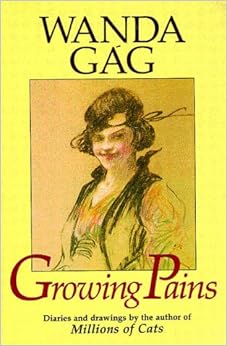 |
| That's a self portrait, on the cover. |
Like so many great things, the Professor introduced me to her. He even gave me the book! And what's really weird is, I wrote this before I saw this. Spooky, eh?
For now, suffice to say, Wanda is wonderful and I'll have millions of quotes for you every Wednesday.
With My Nimrodic Powers
The following poem is from Growing Pains, by Wanda Gág:
Oh gee,
How doth the busy bee
Improve the shining hours
By making honey sweet and good
From all the pretty flowers.
Oh my,
How doth this lazy I,
Improve (?) the shining hours
By drawing things
And painting things
With my nimrodic powers.
The book is really her diary, and the drawings she made for the diary are included. It's like reading a blog from one hundred years ago. Wanda Gág was fifteen years old when she wrote about her nimrodic powers. The year was 1909. Thank you, Professor Batty, for the book. It's unbelievably great.

Breaking news from Professor Batty: Nice post, but that isn't Wanda in your picture! It is one of her classmates at art school. Attached is a self portrait (on a piece of groceery bag) that she did for "Armand" with his notes on the back. I found it in with his letters to Wanda along with his notes on the back. I took a pic of it and cleaned it up a bit in PS. To my knowledge it has never been published, but it is out of copyright, feel free to use it.
Oh gee,
How doth the busy bee
Improve the shining hours
By making honey sweet and good
From all the pretty flowers.
Oh my,
How doth this lazy I,
Improve (?) the shining hours
By drawing things
And painting things
With my nimrodic powers.
The book is really her diary, and the drawings she made for the diary are included. It's like reading a blog from one hundred years ago. Wanda Gág was fifteen years old when she wrote about her nimrodic powers. The year was 1909. Thank you, Professor Batty, for the book. It's unbelievably great.
Correction from Professor Batty! This is not Wanda Gág in the photo!
 |
| The real Wanda Gag, as unearthed by Professor Batty, who knows about such things. |
Subscribe to:
Posts (Atom)